
March 13, 2026 • By Dr. Sadok Derouich
Why most EMR software fails outside the US and Europe
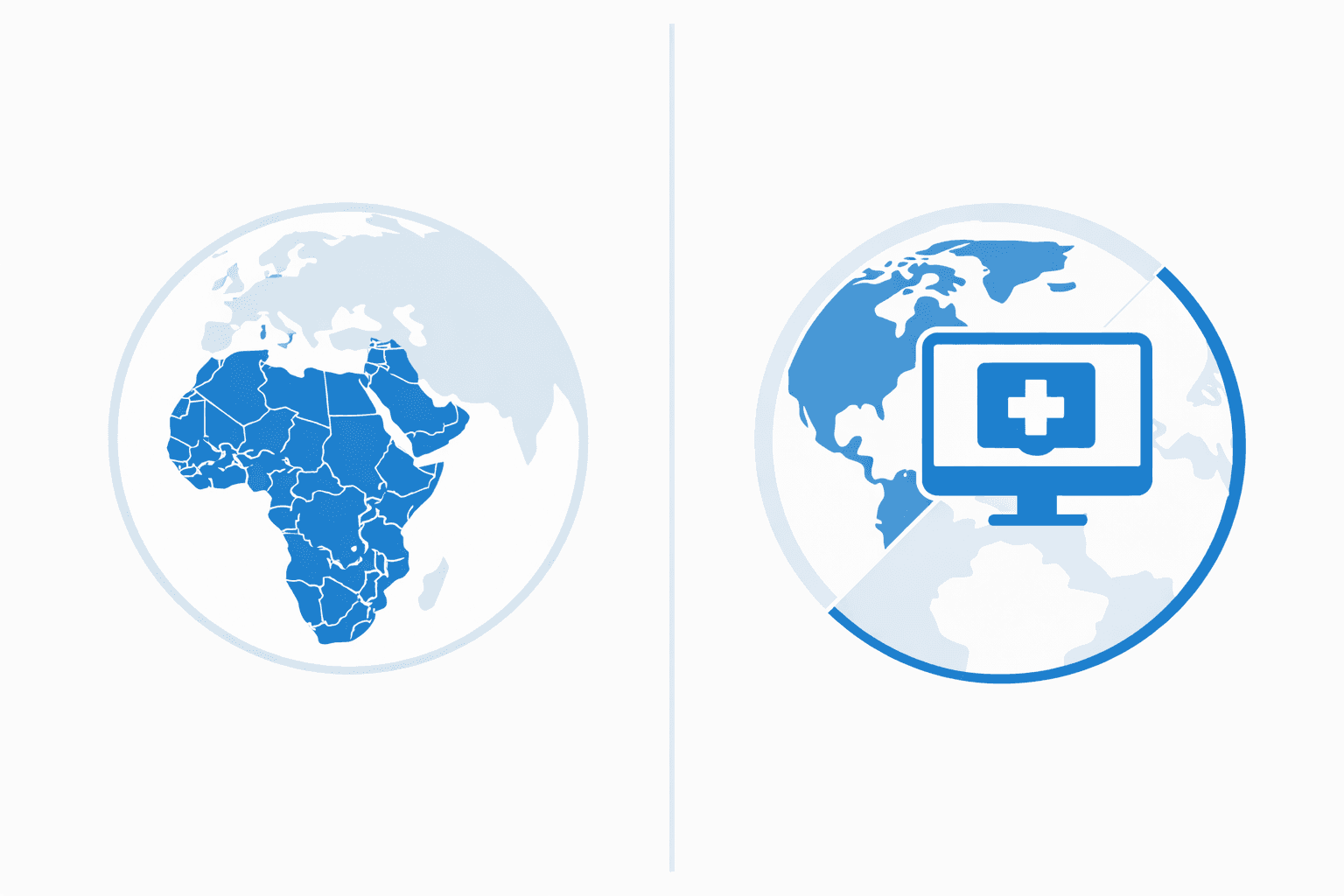
The global EMR market was built for North America and Western Europe — leaving the majority of the world's doctors without tools designed for their reality.
Most EMR software fails outside the US and Europe because it was never designed for those markets in the first place. It assumes insurance billing systems, dedicated IT staff, stable broadband, and payment infrastructure that simply does not exist for most private practitioners across Africa, the Middle East, South Asia, or Latin America. (We discuss our mission to fix this in our About this blog page). The mismatch is not a technology problem — it is a design problem compounded by an access problem.
What you will learn in this article:
- Why the entire EMR industry was built around Western healthcare assumptions
- The 6 specific reasons traditional EMR fails doctors in developing countries — including one almost never discussed
- Why local alternatives largely failed to fill the gap
- What doctors in these markets actually need — and what a different design philosophy looks like
Medical Insight
When I opened my private practice in Tunisia in 2017, I spent weeks evaluating every EMR system I could find. The experience was not a shortage of software — it was a wall of irrelevance. Every product I tested was solving problems that did not exist in my world, while ignoring the ones that did. I was not looking for insurance claim processing or HIPAA compliance dashboards. I was looking for something that worked on my phone, in my clinic, in my country, without a sales call. I found nothing.
Why the EMR Industry Was Built for Western Healthcare — And Why That Excludes Most Doctors
The global EMR market is dominated by platforms built for the United States and, to a lesser extent, Western Europe. North America alone accounts for an estimated 43% of the global EMR market share in 2025 — and the earliest commercial vendors followed that investment concentration.
The result is an industry shaped by assumptions that do not travel well:
- Complex insurance billing and CPT code workflows
- Administrative staff dedicated to documentation
- Stable broadband internet as a baseline assumption
- Multi-doctor clinics or hospital departments as the primary target user
- IT departments available for installation, maintenance, and training
A 2024 systematic review in JMIR identified this mismatch as a core barrier: most EHR systems require extensive local adaptation before they are usable in low- and middle-income country contexts — adaptation that requires resources, time, and technical expertise that most solo practitioners simply do not have.
The numbers reflect the scale of the failure: EHR system failure rates range between 50 and 70% across healthcare settings globally, with rates significantly higher in resource-constrained environments.
| Feature | Paper records | Traditional EMR |
|---|---|---|
| Designed for | Any environment | US/EU hospital or large clinic |
| Infrastructure needed | None | Stable broadband, IT team, hardware |
| Onboarding process | None | Sales call, demo, weeks of setup |
| Monthly cost | Near zero | $76-500+ per month |
| Country availability | Everywhere | Often limited to home market |
The 6 Reasons Traditional EMR Fails Doctors in Developing Countries
1. The Cost Is Prohibitive for Solo Practitioners
In the US, EMR costs can reach 7% of a physician's annual revenue. The average base plan sits at $76 per month — and that excludes implementation fees, training costs, and support contracts. For a solo practitioner in Tunisia, Nigeria, or Lebanon, where patients pay out of pocket and margins are thin, this cost structure simply does not hold.
2. Complexity Designed for Institutions, Not Individuals
A 2024 PMC systematic review identified 13 distinct barriers to EMR adoption in developing economies — with system complexity ranking among the most consistent. Most platforms were designed for hospitals or large healthcare networks, with features like insurance processing, multi-department workflows, and regulatory compliance dashboards that create friction without delivering value to a solo clinician.
In my daily practice, I did not need a procurement module or a claims dashboard. I needed to open a patient file, record my notes, and write a prescription. Anything beyond that was friction I could not afford.
3. Country-Specific Architecture That Cannot Be Adapted
Many platforms are deeply embedded in the administrative infrastructure of a single country — US-built systems depend on CPT codes, HIPAA frameworks, and insurance network integrations. These are not optional features. They are load-bearing walls of the architecture that cannot be removed or adapted without rebuilding the product — which vendors have no financial incentive to do for markets representing a small fraction of their revenue.
4. The Sales-First Onboarding Model Excludes Busy Doctors
Enterprise EMR vendors use a sales-driven adoption process: contact a representative, schedule a demonstration, negotiate a contract, wait for onboarding. A 2022 study on EMR adoption in Nigeria found that perceived usefulness had an odds ratio of 18 on adoption — meaning immediate value demonstration was the single strongest predictor of whether a doctor would adopt the system. The enterprise sales process prevents that demonstration from ever happening.
5. Many EMR Systems Are Simply Not Available in These Markets
Many vendors do not offer their software outside their home country at all — not because the technology cannot work there, but because the business model was never built around global distribution. The result: millions of doctors who want to go digital cannot find a solution designed for their context and continue working on paper by default.
6. The Payment Barrier Nobody Talks About
This is perhaps the most overlooked obstacle of all — and the most concrete.
In many developing countries, doctors cannot pay for international software subscriptions even if they want to. Foreign exchange controls in countries like Nigeria, Algeria, and across the WAEMU region make cross-border payments legally complex or practically impossible for individual practitioners. Research on African payment infrastructure documents how strict exchange rate controls mean that sending money outside the country often requires going through a bank branch, presenting formal documents, and sometimes obtaining regulatory approval — for what amounts to a $19/month subscription.
Stripe, the payment processor used by most SaaS companies, is not available in many African countries. PayPal has limited or no functionality in several MENA markets. A doctor in Dakar or Algiers who finds a product they want to buy may simply have no viable way to pay for it using the international currency the vendor requires.
This is not a minor friction point. It is a complete wall — and one that almost no digital health company has bothered to address.
Medical Insight
I have spoken with colleagues in Senegal, Lebanon, and Morocco who described the exact same experience I had in Tunisia. They found the software, they wanted to use it, they were ready to pay — and then they hit a wall. Either the system asked for an NPI number that does not exist in their country, or tried to connect to a billing system that was irrelevant, or the payment page rejected their card entirely because their bank does not support international transactions. The barrier is not access to information. It is access to the product itself.
Why Local Alternatives Also Failed
The logical response to this gap was for local developers to build their own solutions. This happened — and the results were largely disappointing.
In Nigeria, by 2018, there were at least 14 local EMR vendors operating in the market, according to a documented analysis of the Nigerian health tech sector. Most had only a handful of hospital users. EMR adoption remained, in the words of the same analysis, "abysmal."
The pattern that emerged was consistent: local startups built solutions, but they replicated the complexity of Western systems rather than reimagining them for their context. They built for hospitals and large clinics — because that is what EMR software was supposed to look like — in a market where the majority of practitioners are solo doctors in small private offices. The addressable market was too fragmented and too small to sustain that business model, and most of these companies eventually collapsed or were acquired.
This history raises two questions that deserve their own dedicated exploration — and that we will address in upcoming articles:
In the era of AI-assisted coding, could the end user — the doctor themselves — build a solution tailored perfectly to their own workflow? The cost of software development has collapsed. A practicing clinician with domain expertise and access to AI coding tools may now be better positioned to build their own clinical software than any outside vendor.
And second: should we be building borderless EMR products designed from the ground up for global deployment, rather than adapting country-specific systems after the fact? What would a truly universal medical office app look like — one with no country dependencies, no currency restrictions, and no assumption that its users have a billing department?
What Doctors in These Markets Actually Need
Strip away everything a solo practitioner in a developing country does not need, and the requirements become remarkably simple:
- A patient file system that works from a smartphone
- Voice dictation — no keyboard required
- The ability to digitize existing paper records with a phone camera
- A tool that works on 4G without stable broadband
- No IT setup, no training, no sales call
- Local payment options — not just USD credit card processing
- A price that reflects the economic reality of small private practice
This is not a low-bar requirement. It is a different design philosophy — one that prioritizes mobility, simplicity, and universality over the feature complexity that Western markets reward.
Practical Steps to Find a Medical Office App That Works for Your Context
If you are a doctor practicing outside the US or Europe, here is how to evaluate any medical office app before investing time in it:
- Ask explicitly: does this work without country-specific billing codes or insurance integration?
- Test it on your phone on a 4G connection — not on a demo computer in a stable office
- Check if you can start using it today without a sales call or onboarding session
- Confirm there is a paper-to-digital migration path using your phone camera — not manual re-entry
- Verify payment options — can you pay in your local currency or through a method available in your country?
- Look for reviews from doctors in your region, not just US or European testimonials
doctoLys was built specifically to pass all of these tests. It runs entirely from a smartphone, works on 4G in any country, requires no country-specific configuration, and can be set up in under 5 minutes — by a doctor who faced exactly these barriers firsthand.
In our next article, we dive deeper into the architectural solution: whether EMR software should be country-specific or genuinely borderless.
Frequently Asked Questions
Why do most EMR systems not work in developing countries?
Most EMR platforms were built around US or European healthcare infrastructure — insurance billing codes, regulatory compliance systems, and broadband requirements that do not exist in most developing country contexts. Vendors have no financial incentive to adapt their products for markets that represent a small share of global revenue.
Can doctors in Africa or the Middle East even pay for international software subscriptions?
In many countries, this is a concrete barrier. Foreign exchange controls in countries like Nigeria, Algeria, and across the WAEMU region make cross-border payments legally complex for individuals. Many international payment processors are not available in these markets, meaning a doctor who wants to subscribe simply cannot complete the transaction.
Why did local EMR solutions fail in markets like Nigeria?
Most local startups replicated the complexity of Western EMR systems rather than redesigning them for their context. They built for hospitals and large clinics in markets dominated by solo practitioners. The addressable market was too fragmented and too small to sustain that business model, and most collapsed or were acquired.
What is the average cost of EMR software for a solo doctor?
The average base plan costs around $76 per month according to 2024 market data, excluding implementation, training, and support fees. For US practices, total EMR costs can reach 7% of annual revenue — a cost structure that is simply not viable for most solo practitioners in developing markets.
What should I look for in a medical office app if I practice outside the US or Europe?
Look for smartphone-first design, no country-specific billing requirements, self-onboarding without a sales call, paper record migration via phone camera, 4G compatibility, local payment support, and transparent pricing without implementation fees.
Built for Doctors the EMR Industry Ignored
doctoLys was designed by a doctor practicing in Tunisia — for doctors practicing everywhere else the industry forgot.
Written by Dr. Sadok Derouich, a practicing gynecologist since 2012, digital health entrepreneur, and CEO of doctoLys — the AI medical office app built for doctors worldwide.

About the Author
Dr. Sadok DerouichDr. Sadok Derouich is a practicing gynecologist since 2012, digital health entrepreneur, and CEO of Doctolys — the AI medical office app built for doctors worldwide.
View Derouich's profile →Stay Updated
Get the latest insights on AI in medicine delivered to your inbox.